
NOV. 7, 2026
5 Min Read
In January 2026, Lumenalta®had two Databricks MVPs and no Partner Champions validated through the panel Databricks runs today. As of October, we have 13. Ten earned the certification while working for Lumenalta®, through a program I built and run on a fixed quarterly cadence. Three are Databricks experts who were already Champions when they joined.
The Brickbuilder Partner Network now spans more than 8,000 partners (Databricks, June 2026). Across all of these partners, there are 372 Databricks Partner Champions in North America.
Thirteen sit at Lumenalta®. In an ecosystem that size, certifications are table stakes. What separates a partner is how many people can stand in front of a customer, defend an architecture, and earn the trust of the Databricks field team. That is what a Champion is.

A short bench is risk you inherit
Every Databricks partner has a short list: two or three names everyone calls when a deal gets technical. I was one of them. It feels like a compliment. It is actually four kinds of risk sitting in two or three heads:
- Delivery risk: one person becomes a single point of failure.
- Presales risk: credibility doesn't scale past whoever is in the room.
- Quality risk: architecture decisions vary from project to project when there is no shared bar.
- Retention risk: strong people leave when they can't see a next step.
If you are buying, that risk becomes yours. At Lumenalta®, it is sharper because of how we work: no solution goes to a customer without a technical expert behind it. Expert-led solutioning only works if you have enough experts. So the program had one job: turn the short list into a long one.
From talent initiative to business lever
Since early 2026, Partner Champions have been one of the inputs to Databricks partner tier scoring. When I put that in front of our executives, the program stopped being a talent initiative and became a business decision.
It has never had a budget line. Its cost is time: mine as the owner, and the candidates' hours, which leadership treats as part of their development rather than a side project. The rest of the ask is just as concrete. Make the title visible when someone earns it. Give Champions a career path. And keep investing after the badge. A Champion who goes back to exactly the same job has no reason to act like one.
The operating model
Coaching people one at a time caps out fast, so we built a structured pipeline instead: three candidate tracks, a ten-week cadence, about three months from entry to Champion, and a new cohort every quarter.
Design backward from the panel
Databricks publishes what its Partner Champion panel covers: your journey, a deep dive on a real project and its architecture decisions, lessons learned, how you influence customers, community contribution, and your plans as a Champion.
I had sat in front of that panel myself. We built a week of the program against each topic.
Run tracks, not a single cohort
Not everyone starts in the same place.
| Track | Entry bar | Target | Timeline |
|---|---|---|---|
| Active | Professional-level certification, hands-on delivery | Panel-ready | About 3 months |
| Opportunistic | Associate-level certification, hands-on experience | Professional-level, then Active | 3 to 6 months |
| Future | Hands-on experience, no certification yet | Associate-level, into the pipeline | 6+ months |
Measure readiness, not certifications
Every candidate is scored on entry against a 100-point diagnostic, then re-scored before their mock panel.
| Section | Points |
|---|---|
| Technical depth | 30 |
| Project and customer impact | 20 |
| Presales readiness | 15 |
| Storytelling and communication | 15 |
| Certifications | 10 |
| Community and leadership | 10 |
Certifications carry 10 of the 100 points. They are the ticket in, not the measure of readiness. The other 90 are what a Champion actually does.
Gate the real panel with ours
Weeks 1 to 3 build the foundation: a project baseline, the presales and architect mindset, and a personal narrative. Weeks 4 to 6 are depth and proof: an architecture deep dive, a real contribution to our internal IP, and a live demo. Weeks 7 to 10 are readiness, ending in at least one mock panel with a Go or No-Go. Nobody goes to Databricks until they have passed ours. All ten in-house Champions passed the Databricks panel on the first attempt. We built all of it on Databricks' own Partner Academy, Partner Solutions Architect Essentials, and Partner Champion guide rather than parallel infrastructure.
Build around active consultants, not the bench
Bench time ends when the next project starts, usually before a candidate is ready. Scott Davis, our other Databricks MVP, had seen that pattern earlier in his career, so we designed for consultants on active delivery from day one. Only one candidate has ever come from the bench, and only for a few weeks. Active candidates spend roughly 12 to 16 hours a month on the program, inside the development time every consultant already has, and their engagement leads plan for it. When it is relevant, we tell the client. Every time, the client has been glad: they get a stronger consultant on the platform they have already chosen.
Give every gap its own rep
The diagnostic shows each person what to work on. Someone new to presales shadows live discovery calls. Someone who can build but not yet present gets a real slot presenting their own project's architecture to an audience that can push back. Someone whose writing isn't there yet drafts a blog and revises with my feedback until it lands.
Turn graduates into mentors
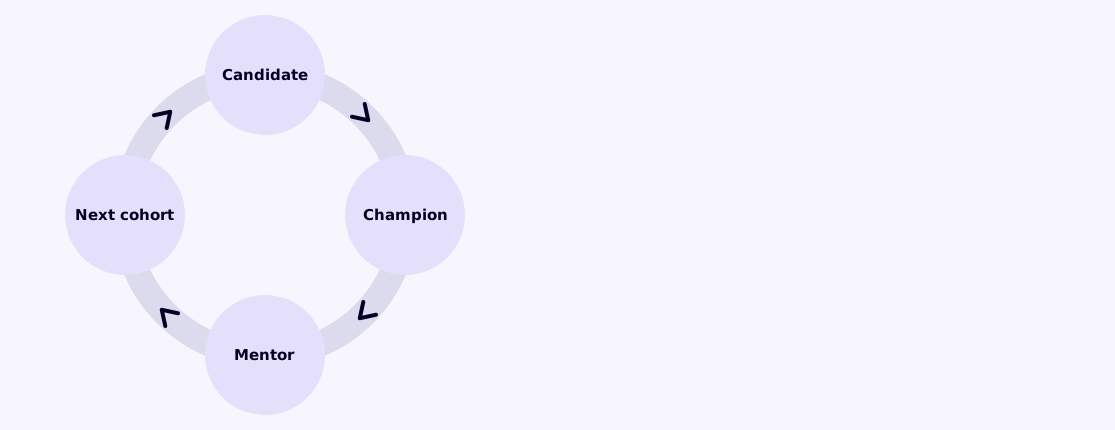
Every Champion comes back for the next cohort to review mock panels, critique drafts, and help candidates rehearse demos. Each graduating class adds coaching capacity back into the program, which is how a program with one owner keeps scaling.
Measure it
Every quarter we track candidates onboarded, time to Champion, panel pass rate, presales involvement, Champion retention, and Champion contribution in complex deals. That is how I answer "is this working" with a number instead of a feeling.
What it produced

The numbers: 13 panel-validated Champions, 10 grown in-house, about three months to Champion, a 100% first-attempt pass rate, and at least two more graduates targeted before the end of 2026. Every Champion we have grown is still with us.
What I'm proudest of is what they did next. One built and now owns our data governance practice. Three authored our internal solution accelerator, which speeds up solutions on customer accounts and is the basis for the Brickbuilder solution we are registering with Databricks. One leads our Genie ZeroOps initiative, where we hold private preview access and work directly with the Databricks product team. Another leads our Lakebase initiative. And one leads presales, delivery, and the client relationship on an engagement where the client gave him a title of their own: their "Databricks Excellence Lead."
If you are choosing a Databricks partner
A partner's tier tells you how Databricks sees the firm, and it matters. The people tell you more, because they are who show up on your engagement. Ask two questions:
- How many Databricks Partner Champions does the partner have?
- Who, by name, will be on your project?
Champions aren't the only measure of a partner's quality, but they are one Databricks has validated, so you can check it. A partner that answers both questions with names and numbers has depth you can verify.
There is more to evaluating a Databricks partner than these two questions. I cover the full approach in How to evaluate a Databricks partner.
If you are building this at your firm
You don't need the whole engine on day one. You need an owner, a framework, a diagnostic, and three or four people who are close. Then:
- Measure readiness, not certification. Build a weighted diagnostic and coach to it.
- Design backward from the Databricks Partner Champion panel. The bar is published.
- Build around active consultants, not the bench. Plan the capacity on purpose.
- Give every gap its own rep: shadowing, presenting their own solution, coached writing.
- Turn graduates into mentors so the program renews itself.
And if you are a practitioner aiming to be a Champion yourself, the diagnostic above is your map. Get onto a Databricks project and own a hard part of it. Present your architecture to people who will push back. Write about what you build. The panel rewards depth and influence, not a certification count.
Champions are grown, not hired
The case comes down to three facts. Partner Champions count toward your partner tier. They raise the bar across your practice, from presales through delivery. And they give your best people a reason to stay. For partners, that is worth an executive's attention. For buyers, it is one of the clearest signals of who will actually do the work.
If you are building something like this, or evaluating partners who say they have, reach out. I'd like to compare notes.
With thanks to Xue Yang, our Partner Solutions Architect at Databricks, who has supported Lumenalta®through every step of this journey, and to the colleagues in operations and on our culture team who made room for the program inside everyone's week.
Dilorom Abdullah is Databricks Practice Director at Lumenalta®, a Databricks MVP, and a Databricks Partner Champion.